




Back-office support covers the administrative and operational processes that keep businesses running, from data entry, billing, and payroll to order management, claims processing, and compliance. Organizations typically manage these functions through internal teams, shared services centers, or a business process outsourcing (BPO) partner.
Although back-office teams rarely interact directly with customers, their performance has a measurable impact on financial accuracy, operational continuity, and service delivery. A delayed refund, an invoice discrepancy, or a claim held up by incomplete documentation can create additional costs, disrupt workflows, and undermine customer confidence.
Enterprise organizations are increasingly reassessing how these functions are delivered. According to FTI Consulting’s Global CFO Survey, 34% of CFOs identified outsourcing non-core functions as a strategic priority, while 68% reported that key finance activities were already outsourced, in development, or planned as high-priority initiatives. Meanwhile, KPMG’s Managed Services Outlook Survey, based on 1,224 senior leaders at large global organizations, found that 99% considered managed services a strategic investment priority. These findings reflect a broader shift toward operating models that combine specialized expertise, scalable capacity, and technology-enabled delivery.
Back-office outsourcing is particularly relevant for processes with repeatable workflows, defined quality standards, and measurable performance outcomes. Since 2015, Helpware has worked with more than 400 clients, providing business process outsourcing services tailored to operational requirements. This guide examines the scope of back-office support, the functions it covers, the differences between in-house and outsourced delivery, and the factors enterprise leaders should consider when selecting an operating model.
Key takeaways
- Definition: Back-office support covers the administrative, financial, and operational processes that underpin business performance, including billing, payroll, data management, and claims processing.
- Front office vs. back office: Front-office teams manage customer and stakeholder interactions; back-office teams execute the processes, transactions, and controls that support those interactions.
- Delivery models: Organizations can manage back-office operations internally, consolidate them in shared services centers, or outsource selected functions to a BPO provider.
- Outsourcing strategy: High-volume, repeatable processes with clear performance metrics are often strong candidates for outsourcing, provided governance, security, and quality requirements are defined.
- AI and automation: Technology-enabled back-office services can improve processing efficiency and data handling, while human oversight remains important for exceptions, sensitive decisions, and quality control.
What Is Back-Office Support?
Back-office support encompasses a range of essential tasks and services that keep a business running smoothly without directly engaging with customers. These include administrative duties, data entry, payroll management, human resources, and various support functions.
Without a solid back-office structure, companies may encounter inefficiencies and time-consuming processes, which can hamper productivity and drive up operational costs. The lack of specialized expertise can even result in lower-quality output and an increased risk of errors when tackling complex tasks.
Furthermore, the absence of scalability options may limit the company’s agility in responding to clients’ demands, thereby hindering potential growth opportunities. By leveraging the expertise of a well-seasoned BPO partner, companies can streamline their back-office operations, enhance quality, and gain the flexibility to scale up.
The responsibilities handled by back-office employees can’t be underestimated for maintaining the company’s stability and functionality. Some key activities include:
- Database administration: Managing and organizing company data to ensure it is accurate, secure, and easily accessible for business operations.
- Finance management: Overseeing financial operations, including budgeting, accounting, and financial reporting, to ensure the company’s fiscal health and compliance with financial regulations.
- Human resources management: Handling recruitment, employee relations, payroll, and benefits administration to maintain a productive and satisfied workforce.
- Legalization and tax payment processes: Ensuring the company complies with all legal requirements and tax obligations, including filing necessary documents and managing tax payments.
- Customer order management: Coordinating the processing of customer orders from receipt to delivery, ensuring timely and accurate fulfillment.
- Digital content generation: Creating and managing digital materials, such as website content, social media posts, and marketing collateral, to enhance the company’s online presence and engagement.
- Technical support: Providing assistance with technical issues and troubleshooting problems to ensure the smooth operation of systems and devices.
- IT development: Developing and maintaining the company’s information technology infrastructure, including software development, network management, and cybersecurity.
- Claims processing: Reviewing and validating insurance or warranty claims against policy rules so payers and customers get accurate decisions on time.
- Insurance verification: Confirming a customer’s or patient’s coverage and eligibility before a service or a claim moves forward.
Back-Office Support vs. Front-Office Support
Customer contact is the dividing line. Front-office teams speak with customers. Back-office teams process the work those conversations create.
| Aspect | Front office | Back office |
|---|---|---|
| Customer contact | Direct and daily | Little or none |
| Typical functions | Customer service, sales, customer success | Data entry, billing, payroll, claims, order processing, compliance |
| Main goal | Win and keep customers | Keep records, money, and orders accurate and on time |
| Typical measures | Customer satisfaction (CSAT), first-contact resolution, response time | Accuracy rate, turnaround time, backlog, service level agreement (SLA) attainment |
| A failure looks like | A long wait or an unresolved call | A wrong invoice, a late refund, a rejected claim |
The two depend on each other. A customer asks a front-office agent for a refund, and a back-office specialist validates the order, updates the system, and issues the payment. Some functions sit on either side: technical support is front office when agents assist customers, and back office when it keeps internal systems running.
If you outsource both sides, pair back-office work with customer support outsourcing under one set of quality standards.
Examples of Outsourced Back-Office Support Services
When considering outsourcing back-office support solutions, companies must carefully evaluate their specific requirements. This involves an in-depth analysis of internal strengths, weaknesses, and operational gaps. Additionally, they need to understand their client’s needs, expected response times, and desired service quality levels.
Through a strategic outsourcing strategy, companies can organically integrate third-party aid into their operations, optimizing efficiency, scalability, and service delivery. This proactive approach not only addresses immediate operational challenges but also positions the organization for long-term success. Here are some of the most important outsourced back-office support solutions:
Content moderation
Content moderators are responsible for overseeing user-generated content submitted to an online platform. The primary objective is to ensure that all content is appropriately categorized, fraud-free, and clean of any material that might hurt the brand. Many businesses are turning to outsourcing content moderation to efficiently manage and maintain their online communities.
Data entry
Back-office data entry often pertains to financial data, encompassing information from your organization, clients, and candidates. This process involves inputting, organizing, and filtering data to promote a more effective decision-making process.
Virtual assistance
Virtual assistants specialize in providing administrative services to clients. Tasks include arranging appointments, managing email accounts, scheduling business meetings, making phone calls, and other administrative duties.
Market research
Back-office responsibilities also include conducting market studies, data collection, analysis, and other research efforts. Collecting and analyzing research data is crucial for the productive operation of the entire company, underscoring the critical nature of this activity.
Order processing
The order processing stages include picking, sorting, tracking, and shipment activities. This is essential in retail trade, as the reliability, responsibility, and accuracy of the back office are key to meeting customer needs.
Image and video annotation
This task involves labeling graphic content. These annotations enable digital tools to interpret visual data for further operations, facilitating advancements in machine learning and artificial intelligence.
Payroll/Accounting/Billing
Financial operations are a cornerstone of back-office support. Specialists handle tasks such as producing annual financial reports, balance sheets, cash flow statements, and account reconciliation reports. Additionally, medical billing services ensure accurate processing of patient invoices and insurance claims, maintaining the financial health of healthcare providers.
Transaction processing
Transaction processing functions involve executing essential business operations, such as employee accounting or ticket reservations, ensuring an efficient, fast-paced running of business activities.
Claims processing
Claims teams receive, review, and validate claims against policy rules, then route exceptions to a specialist. Helpware teams handle healthcare claims processing under HIPAA requirements. Volumes rise and fall through the year, so claims processing outsourcing gives health plans capacity they adjust month to month.
Insurance verification
Insurance verification services check coverage, eligibility, and benefits before an appointment, a procedure, or a claim. Catching a coverage gap at this step prevents a claim denial later. Healthcare providers outsource insurance eligibility verification so front-desk staff stay focused on patients.
Back-Office Support Roles and Responsibilities
A back-office support job description changes by function, but most roles share three duties: process transactions by documented rules, keep records accurate, and flag exceptions to a specialist. The table lists common roles on a back-office support team.
| Role | Responsibilities | Typical measures |
|---|---|---|
| Data entry specialist | Enters, validates, and updates records across CRM, ERP, and billing systems | Accuracy rate, records per hour |
| Billing and accounts specialist | Issues invoices, posts payments, reconciles accounts, follows up on receivables | Invoice accuracy, days sales outstanding |
| Payroll and HR administrator | Runs payroll, maintains employee records, administers benefits, and onboarding paperwork | On-time payroll runs, error rate |
| Claims processor | Reviews and validates claims against policy rules, routes exceptions | Turnaround time, first-pass accuracy |
| Insurance verification specialist | Confirms coverage, eligibility, and benefits before service | Verifications per day, eligibility-related denials |
| Order processing specialist | Enters orders, tracks shipments, processes returns, and refunds | Order accuracy, order cycle time |
| Content moderator | Reviews user-generated content against platform policy | Decision accuracy, review time |
| Data annotator | Labels images, video, and text for AI model training | Label accuracy, throughput |
| Quality analyst or team lead | Audits samples, coaches the team, reports on SLAs | Quality score, SLA attainment |
Hiring for these roles in-house means recruiting, training, and backfilling each one. An outsourcing partner staffs them as one team with shared quality checks and reporting. A finance team, for example, combines invoice processing with accounts receivable outsourcing.
Moderators and annotators belong to data operations teams, which work to the same accuracy and turnaround measures.
In-House vs. Outsourced Back-Office Support
Both models work. The right choice depends on volume, how stable the process is, and how much control you need.
| Factor | In-house team | Outsourced team |
|---|---|---|
| Cost structure | Fixed: salaries, benefits, software, office space, management time | Variable: fees that scale with team size or volume |
| Scaling | You recruit, train, and backfill | The provider adds or removes capacity |
| Control | Direct, day to day | Through SLAs, reporting, and regular reviews |
| Expertise | Built over time, role by role | Trained specialists and tested processes at launch |
| Coverage | Business hours unless you add shifts | Extended or 24/7 coverage across time zones |
| Compliance | You own every control | Shared: the provider brings certified controls, and you keep accountability |
| Best for | Strategic, sensitive, or fast-changing work | High-volume, rule-based work with clear quality measures |
Keep a process in-house when it carries proprietary knowledge, changes every few weeks, or runs at low volume. Outsource it when the workflow is documented, volumes are high or seasonal, and you measure quality with numbers.
Document the process before you move it. An undocumented workflow carries its problems to the new team. Plan for the risks of outsourcing before you sign: data security, loss of visibility, and a slow handover.
Location is part of the decision: offshore outsourcing trades proximity for lower labor costs and longer coverage hours.
Small business owners weigh the same trade-off in public. An r/smallbusiness thread on Reddit asks, does outsourcing your bookkeeping and accounting help you sleep?
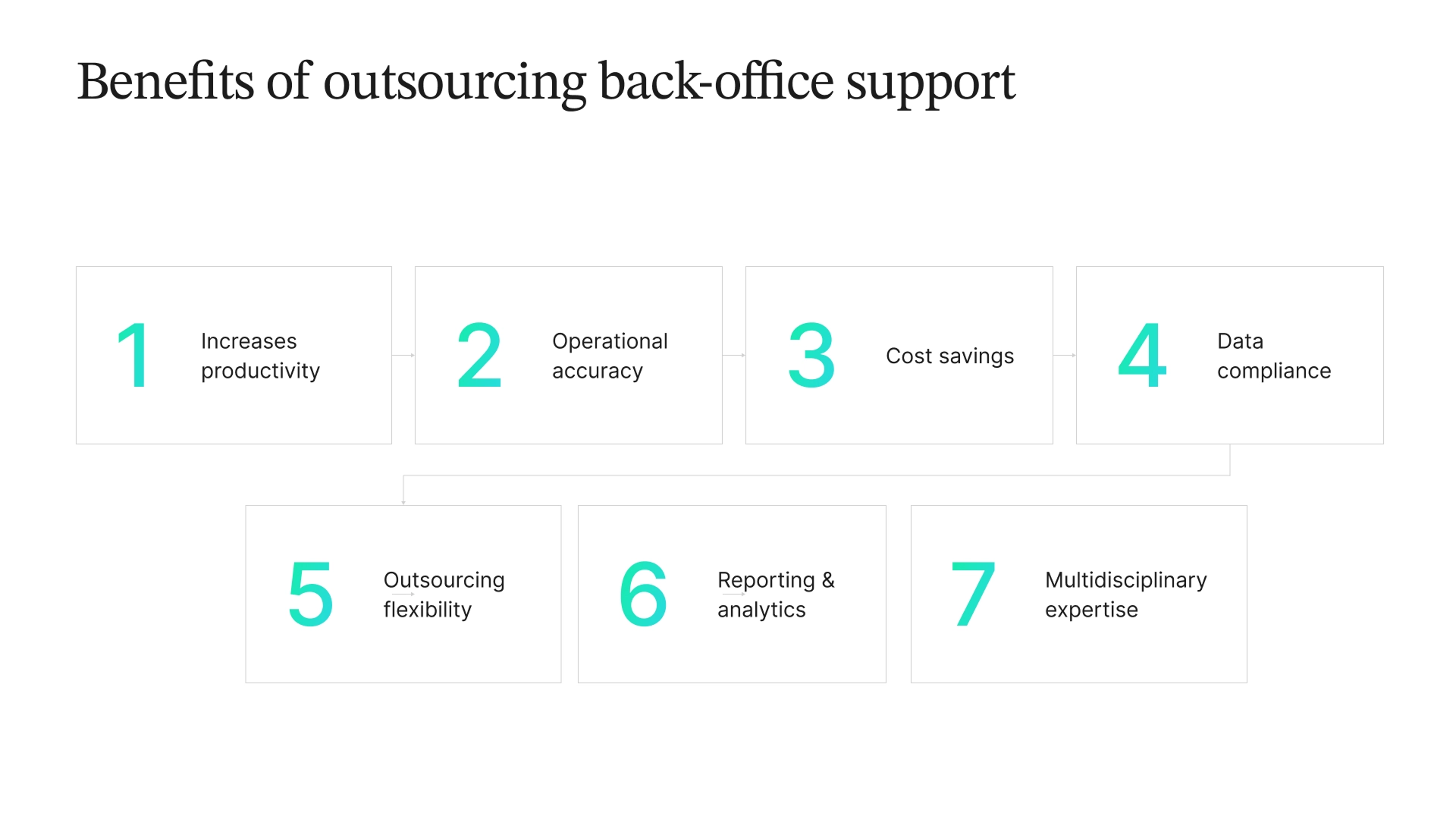
Top 7 Advantages of Outsourcing Back-Office Support
Optimizing business operations has become a top priority for upscaling organizations. Despite this focus, many companies struggle to achieve their goals due to an inability to identify areas needing improvement and to implement cohesive streamlining strategies. Outdated infrastructure and insufficient resources further complicate these efforts.
Here are some examples of the most relevant perks of outsourcing professional back-office support services:
Increases your overall productivity
Back-office staff handle time-consuming tasks, equipping frontline employees with vital information. This support enables a seamless workflow, allowing client-facing personnel to be proactive and enhance their productivity. In one healthcare technology engagement, Helpware introduced an AI-assisted intake solution that reduced agent call time by 23% and peak agent headcount by 13%, without compromising support quality. Explore how the solution improved operational efficiency.
Enhances operational accuracy
Minimize the risk of errors in every department inside your business. This reliability in financial reporting supports better decision-making and future planning. Back-office support ensures all invoices are correctly recorded, and payments are meticulously tracked, especially when using online payment software, preventing discrepancies in financial records. In a healthcare engagement, Helpware helped a client achieve 99.5% order accuracy and 100% case completion while meeting its support targets. See how the healthcare company improved order accuracy.
Promotes cost savings
Outsourcing back-office tasks can result in substantial cost savings by eliminating the need to hire and train in-house employees for multiple functions. With experts handling tasks such as payroll and taxes, companies can save both money and resources, redirecting them towards more strategic initiatives.
Improves data compliance and security
These services can support compliance by applying documented procedures and appropriate security controls to sensitive business and customer information. However, outsourcing does not automatically transfer regulatory responsibility to the provider. Businesses must assess vendor controls and verify that their arrangements meet applicable requirements, including GDPR, HIPAA, and SOX where relevant.
Fosters outsourcing flexibility
If a company seeks to maximize its capabilities during peak periods or optimize operations, back-office support offers the agility to adjust resources accordingly. This scalable approach ensures that businesses maintain their operational efficiency while keeping costs low, eliminating the need for extensive in-house resources or infrastructure investments. Helpware’s partnership with a medical transportation provider demonstrates this potential: the team expanded from 45 to 70 full-time employees, with an additional 25-person Medicaid team in the US, while achieving 100% SLA attainment and 99.9% staffing accuracy. Read how the transportation company scaled its support operations.
Speeds reporting & analytics
Reliable financial reports from back-office teams aid in informed decision-making. These workforces analyze and present operational data, helping management identify underperforming areas and make strategic improvements. By providing clear insights, back-office support enhances the business’s ability to make data-driven decisions. For example, Helpware helped a global travel platform reduce inquiry resolution time by 15% and improve service quality scores by 10–20% through structured training, ongoing coaching, and performance improvement initiatives. Discover how the platform improved service speed and quality.
Offers multidisciplinary expertise
One of the greatest advantages of outsourcing back-office services is that you can work with experts in different areas without having to worry about their training. Delegating back-office tasks to experts allows companies to free up internal resources for more critical, strategic activities.
How AI Is Changing Back-Office Support
Back-office work is repetitive and rule-based, which makes it a natural place for automation. In the Deloitte outsourcing survey, 83 percent of executives use AI as part of their outsourced services, and 20 percent are building a digital workforce strategy for their AI and automation bots.
In practice, AI in BPO splits the work into two lanes:
- AI handles the predictable steps: Classifying documents, extracting data from forms and invoices, validating fields against rules, and flagging anomalies.
- People handle the exceptions: Incomplete records, disputed claims, judgment calls, and anything a rule doesn’t cover.
Automate a process only after you’ve documented it. Software repeats whatever rules it’s given, including the wrong ones.
We build AI tools such as quality assurance automation and agent assist into service delivery, and clients have cut costs 20 to 30 percent through AI automation.
Outsource Your Back-Office Support with Helpware
Helpware is an established BPO provider with 19 locations in 11 countries and more than 4,000 team members. Our experience spans a range of back-office functions, from data management and claims processing to billing support and insurance verification. We build dedicated teams around each client’s workflows, systems, operating requirements, and quality standards, combining trained specialists, documented procedures, and performance monitoring to support consistent service delivery.
Our back-office outsourcing services are designed to integrate with your existing operations, whether you need support for a single function or a broader range of administrative processes. Helpware maintains SOC 2 Type II, ISO 27001, and ISO 9001 certifications and applies relevant security and compliance controls in line with applicable requirements, including HIPAA and GDPR.
How We Transition Back-Office Operations to Helpware
1. Discovery and process assessment
We review your current workflows, transaction volumes, systems, business requirements, and existing performance metrics. This helps identify which tasks are suitable for outsourcing and where process improvements may be needed.
2. Solution design and team setup
Based on the assessment, we define the scope of work, staffing requirements, service levels, quality criteria, and reporting structure. We also establish responsibilities, escalation paths, and communication channels between your team and ours.
3. Knowledge transfer and workflow integration
Our team learns your procedures, tools, policies, and exception-handling rules. We document workflows, prepare training materials, and coordinate access to the systems and information needed to perform the work.
4. Pilot and quality validation
We begin with a controlled rollout to test the workflows, validate accuracy and turnaround times, and identify gaps before expanding the scope. Performance is reviewed against agreed targets, with adjustments made where necessary.
5. Ongoing delivery and optimization
Once the operation is established, we monitor performance, report against service-level agreements, review recurring issues, and refine workflows as business needs change. Capacity can be adjusted as transaction volumes and operational requirements evolve.